
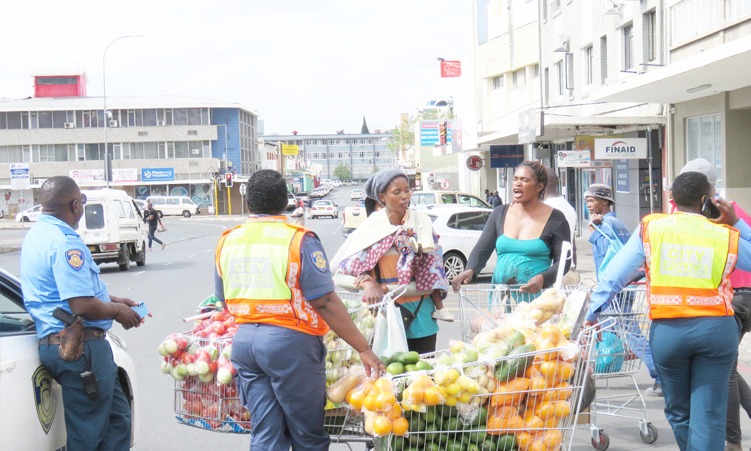
… Enduring the heat and running from the police
IMELDA AMBONDO
At 6:00, Fransina Titus (42) leaves her home at Goreangab and heads to the streets of Windhoek.
She works until 18:00, standing for hours, watching the road, hoping customers will stop and buy water, sweets or snacks from her.
“I was motivated by poverty,” she says.
Since October 2025, selling sweets, water and snacks has been Titus’ only source of income. In a week, she earns between N$500 and N$600, money she said is hard-earned and not enough to meet her needs.
While trying to survive, she faces constant challenges. The biggest is enforcement, they are being chased away by the police because they sell in prohibited areas.
“The City police sometimes chase us away , because we are not allowed to sell on roads, ” Titus said.
She explains that customers often complain that goods sold by street traders are expensive, but few understand the reality behind survival. Trading at designated selling points is not an option for her.
“Designated selling areas are already full and expensive,” she said. .
Another street hawker, Jacob Enok, said his day starts even earlier. At 5:30, he is already on the streets selling a variety of snacks and drinks , returning home around 16:30. He has lived this routine since 2020.
“My children motivate me,” Enok said.
Street trading is how he provides for his family. His weekly income is about N$500, which he says barely sustains his household. Like Titus, enforcement remains his biggest struggle.
“We are chased away by the City Police, I plead with people to support me and buy my things so I am able to earn a living” he said.
Both Titus and Enok say life on the streets is not a choice but a response to desperation in a city where living costs are high and jobs are scarce.
POVERTY AND CHAOS
According to Rinaani Musutua of the Basic Income Grant Coalition of Namibia, the country’s socio-economic situation is marked by a direct link between poverty and societal chaos.
She points to Namibia’s 50% unemployment rate, the highest in the Southern African Development Community (SADC), which leaves many people without formal employment.
She describes this as a sign of a failed economy, “forcing individuals to engage in street vending at unsolicited locations as a desperate means of survival.”
Musutua says this creates what she calls “survival anxiety.” To ease this pressure, she proposes a Universal Basic Income Grant of N$500 per person per month for all Namibians aged 0–59, saying it would help subsidise basic necessities and reduce daily struggles.
She also highlights Namibia’s wealth in minerals and fishing grounds, saying that “despite being a rich nation… many Namibians remain in abject poverty, and that the country could afford such a grant by leveraging its resources.”
On enforcement, Musutua criticises current approaches as unsympathetic. She says City Police often use excessive force against street traders who are trying to feed their families, and that vendors should be given time to vacate unauthorised areas instead of facing immediate arrest.
She said government policies must be aligned with people’s realities to ensure that every citizen has “something to eat at the end of the day.” She warned that as long as poverty, inequality and unemployment remain high, street vending will continue to be part of Namibian life.
As street trading becomes more visible across Windhoek, the City of Windhoek says it is aware of the situation and the pressures behind it.
BROADER ECONOMIC CHALLENGES
City spokesperson Harold Akwenye told Namibia Business Review that informal and roadside trading reflects broader economic pressures, including unemployment and urban migration. He says the City manages street trading through its municipal police, economic development and planning divisions, guided by existing by-laws and council-approved frameworks.
According to Akwenye, enforcement focuses on public safety, traffic flow and sanitation. “Where traders operate in restricted or unsafe areas, officials first engage through education and compliance notices, with enforcement applied where non-compliance persists, especially in high-risk areas such as road reserves and busy intersections.” Akwenye says.
On fines, Akwenye said penalties are issued under municipal by-laws and vary depending on the offence, repeat violations and location. He adds that fines are intended as deterrents rather than punitive measures and are applied with due process.
Looking ahead, Akwenye said the City recognises informal trading as an important survival mechanism and is working on long-term solutions.
“These include identifying and formalising trading areas, integrating traders into local economic development planning, reviewing trading frameworks and exploring partnerships that allow traders to transition into more secure and regulated environments.”
GROWING UNEMPLOYMENT
Labour researcher and social justice activist Herbert Jauch says the rise in street trading is directly linked to increasing unemployment.
“The increase is not surprising, people struggle to survive, ” Jauch said.
He said without income, unemployment insurance or a basic income plan, people are forced to do whatever they can to survive.
“Street traders face restrictions on where they are allowed to operate and often feel pushed into certain areas,” he said.
Jauch said the solution lies in authorities sitting with trader representatives to discuss and negotiate possible solutions, creating a city that is more accommodating to informal traders.
COMMENTS