
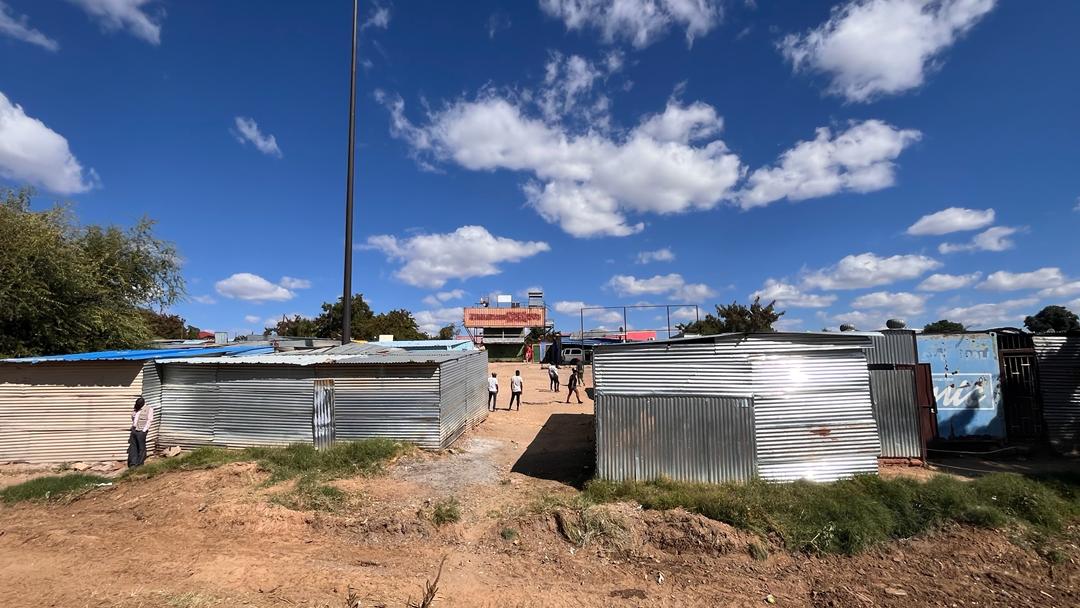
Herero Mall’s 20-year wait for development as crime and neglect persist
VERIPUAMI KANGUMINE
At the end of every month, Herero Mall in Katutura transforms into a crowded and noisy nightlife hub. People flood the informal market to eat grilled meat, drink at shebeens, and dance late into the night to popular songs with the playlist dominated by musician One Blood. What is usually a working space by day becomes a packed entertainment zone that draws hundreds of people from across Windhoek.
Herero Mall, despite its name, is not a formal shopping centre. It is an informal business hub in the heart of Herero Location that has been operating for more than 23 years. Over time, it has grown into a dense economic space with more than 40 shebeens, restaurants, salons, car wash operations and upholstery businesses. Its central location and strong entertainment culture continue to attract customers every month, especially at month-end when money circulates.
But behind the busy trading and nightlife, many traders say they are living under pressure. The same crowds that bring customers and income also bring fear. Traders say break-ins, theft and vandalism increase during peak periods, forcing some business owners to take extreme measures to protect their property.
For Uakutura Ngonga, a self-taught carpenter who runs a small workshop at the mall, month-end is no longer just about sales, it is about survival. His corrugated sheet workshop is packed with kitchen cabinets, wardrobes, nightstands and tables. Since buying the two-room shack from a previous owner early last year, he says he has already experienced two break-ins.
Ngonga says the situation has forced him to sleep inside his workshop whenever the month ends. “I sleep here at the end of the month to stop people from breaking into my workshop and stealing or vandalising my property,” he said. For him and others, the absence of security guards and CCTV cameras has created a constant sense of vulnerability. Traders say they are left to protect themselves in a space that is otherwise heavily crowded and active.
While business activity is booming, crime has left a painful history at the mall. Between 2007 and 2022, four people were killed in separate incidents at Herero Mall. In 2022, a Windhoek City Police officer shot a suspected burglar after an alleged attempt to attack the officer with scissors. In 2021, the body of 22-year-old bartender Leevi Kondjeni Paulus was discovered inside a refrigerator in a shebeen. Earlier, in 2011, Alfredo Ndisiro bled to death after being stabbed in the neck and stomach, while Rodney Nuweseb, aged 30, also died at the mall in 2007. These incidents continue to shape how traders and residents view safety in the area.Despite these concerns, Herero Mall remains an important source of income for hundreds of people. The informal hub supports livelihoods through a mix of small businesses that operate daily in a tightly packed environment. Traders say the mall’s location makes it a natural gathering point for customers, especially during weekends and month-end peaks when spending increases.
However, traders argue that the infrastructure has not kept up with the growth of business activity. Basic services such as sanitation, drainage, buildings and security remain limited. Many say this imbalance has slowed development and made daily operations more difficult, particularly during busy periods when the area becomes overcrowded.
THE CITY IS AWARE
The City of Windhoek says it is aware of these concerns but has not yet established a confirmed cost estimate for fully servicing the area. “At this stage, no confirmed cost estimate is available for a fully serviced market at Herero Mall, as costs vary significantly depending on site conditions, design scope, and infrastructure requirements,” said spokesperson Lydia Amutenya.
She added that the City is engaging traders and stakeholders to better understand the challenges on the ground. According to her, discussions are ongoing to identify possible interventions that could improve hygiene, sanitation and infrastructure conditions. The City also says it is open to exploring partnership-based management models similar to those used at the Oshetu Community Market, located at Single Quarters, Katutura but stresses that such approaches require feasibility studies and stakeholder consultation before any decisions are made.
REPEATED CHORUS
For traders, these responses come after years of waiting. The Herero Mall committee says it has been calling for development since the area was first initiated in 2003. Committee head Makena Siwogedi says the group has engaged various city leadership structures over the years, including different mayors, but has seen little progress.
She says the lack of sanitation facilities, proper buildings, drainage systems and security has limited business growth for decades. According to her, even though the mall eventually received electricity in 2022 and was rezoned, traders still face high costs that make survival difficult.
Siwogedi says tenants signed a rental agreement of N$163.69 with the City of Windhoek, while electricity costs remain high at about N$50 per day. She says this is unfair compared to other markets that receive better infrastructure support. “Herero Mall was rezoned to be industrial but the electricity is the same as shopping malls. We are paying N$50 per day for electricity,” she said.
Despite these challenges, experts say Herero Mall plays a critical role in sustaining livelihoods in an economy marked by high unemployment. Sociologist Ellison Tjirera says the demand for proper facilities and better management has existed for years, but the informal market continues to serve as a key survival space for many residents.
Labour researcher Herbert Jauch adds that the informal economy is not optional for many people but necessary for survival. He says the City has an obligation to improve conditions rather than ignore them, stressing that better infrastructure would directly improve traders’ livelihoods.
Business activist Donevel Kariko says the lack of development has also contributed to social concerns within the area, arguing that limited opportunities push many young people into alcohol-based businesses. He also calls for broader youth opportunities that move beyond shebeens and drinking spots.
COMMENTS