
TIRI MASAWI
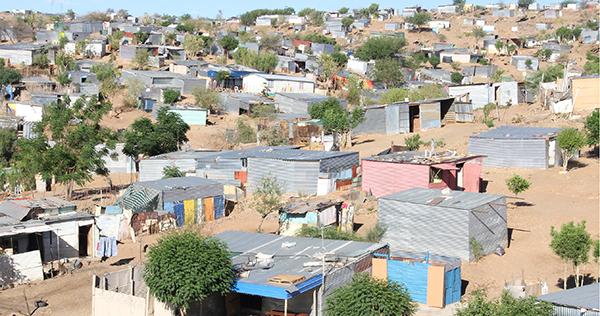
Nearly 600 000 Namibians are still living in informal settlements, highlighting the country’s growing housing crisis despite efforts to speed up land servicing and housing delivery.
The figures are contained in a report prepared by the Economic Task Force and presented to President Netumbo Nandi-Ndaitwah. The committee was appointed to find lasting solutions to Namibia’s housing and land challenges.
According to the report, around 2 million Namibians live in urban areas, with about 600 000 of them living in informal settlements, many without proper housing, electricity and access to clean water in their homes.
This was revealed during media stakeholders’ engagement for the Namibia Public-Private Forum held last week in Windhoek.
Economic advisory committee member Fanuel Manda said the country’s housing crisis is driven by legal obstacles and the failure to build enough houses and service enough land to meet demand.
He said Namibia needs a broader approach that focuses on providing affordable housing for low- and middle-income earners while ensuring that serviced land is made available faster.
“When it comes to sanitation itself we are operating about 70% and water provision we are operating at about 90 percent which is good. On housing we are still struggling and that is where we need to come up with a public private sector solution,” Manda said.
Speaking at the same event Director-General of the National Planning Commission Kaire Mbuende said the Economic advisory committee had identified key areas that need attention to improve the economy and address challenges affecting Namibians.
These include attracting more foreign direct investment, introducing an immigration bill to make it easier for high-end investors to enter the country, and finding practical solutions to the housing shortage.
“One of the most encouraging outcomes of the inaugural Forum was the spirit in which the discussions took place. The government listened with keen interest to the concerns and aspirations of the private sector. Equally, there was a desire by the private sector to engage constructively and to contribute solutions to national challenges,” Mbuende said.
He said solving Namibia’s economic challenges will require close cooperation between government and the private sector.
“One of the concerns frequently raised by both Government and the private sector over the years has been that consultations often produce excellent recommendations without follow up. It was for this reason that Her Excellency the President emphasized that the Namibia Public-Private Forum must distinguish itself not by the quality of the discussions alone, but by the quality of the outcomes that emerge from those discussions,” he said.
Khomas region governor Samuel Nujoma acknowledged that the country continues to struggle to provide enough housing and serviced land for those in need.
“On housing and land delivery, I was tasked with the coordination of the Implementation Plan for the Upgrading and Formalisation of Informal Settlements in the Khomas Region by the Office of the Prime Minister,” Nujoma said.
He said his office is working with the Ministry of Urban and Rural Development, the Ministry of Agriculture, Fisheries, Water and Land Reform, and the Khomas Regional Council. He added that the Ministry of Urban and Rural Development has pledged N$750 million towards the housing programme.
However, he said delays in coordination between the ministry and the City of Windhoek are slowing implementation.
“The City of Windhoek has completed layout designs for 11,226 proposed erven across 18 townships, with a combined CAPEX of N$296.4 million earmarked for land servicing and housing delivery in the 2026/27 Financial Year, targeting Cimbebasia, Otjomuise, Rocky Crest, Havana, Goreangab and Okahandja Park,” he said.
Nujoma said the City has also built 194 communal toilets and 227 communal water points, increasing sanitation coverage by 16% and water-point coverage by 22%.
He added that the Khomas Regional Council has invested N$3 million in drilling and rehabilitating boreholes and installing water pumps across 11 rural settlements.
“The City’s Water and Wastewater Infrastructure Master Plan, approved in 2025, requires N$11.72 billion over a twenty-year implementation period, with the upgrade of the Gammams Wastewater Treatment Plant and an additional Direct Potable Reclamation Plant already secured through grant and loan financing,” he said.
Nujoma said building activity in the region is also increasing.
“Regional building plan approvals grew by 47% year-on-year, reaching a value of N$2.89 billion in 2024/25, creating opportunities for Khomas residents, local contractors and suppliers. Under the Mass Housing Development Programme, 304 housing units are being constructed in Windhoek, with housing delivery also supported through the Build Together Programme and the Shack Dwellers Federation of Namibia,” he said.
COMMENTS