

The Roads Contractor Company (RCC) has recently come under public attention over its role in delivering road infrastructure in Namibia, its partnerships with foreign companies, and its ability to operate on a financially sustainable basis. Works and Transport Minister Veikko Nekundi has said that RCC, which has received significant government support over the years, must now show stronger commercial performance and improve project delivery.
Questions have also been raised about whether RCC’s contracting model creates enough opportunities for local contractors and job creation, particularly when working with foreign firms on major projects.
Namibia Business Review spoke to RCC Chief Executive Officer Dasius Nelumbu to get his responses on these issues.
NBR: Can you briefly outline the current operational status of RCC and its overall performance at present?
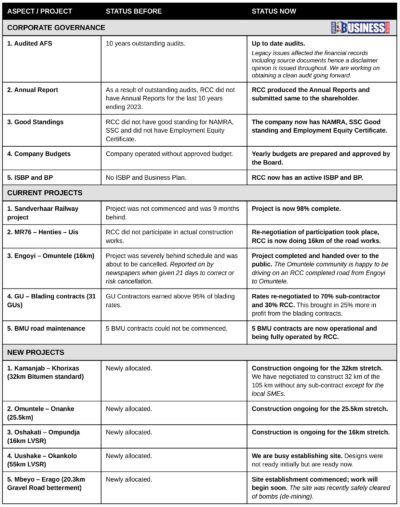
Nelumbu: It is unfortunate that by default, public only see the little remaining stains on “work in progress” of cleaning and bringing RCC to where it should be, I have been RCC Interim CEO for a little over 18 months now, and without a shadow of doubt, a number of strategic results are very evident. Below is a snapshot of what we collectively (Myself, My Management and Staff and My Board) have achieved collectively in the last 18 months.
It is in the public interest to take stock of what we have done thus far, we have leveraged our projects to bring in 38 brand new equipment and a crusher, new equipment means un-interrupted production.
Go to Omuntele, Ompundja, Kamanjab or to UIS, our new equipment are there for public to see.
Be mindful that there are groups of people who are not happy to see the raise of RCC as it would eventually become a formidable construction industry player, this is not good news to some, this is why they are on a mission to create chaos at RCC, disturb good progress and using some of our old employees to sabotage work.
And in some cases using state institutions like ACC to fight their battles, this I can speak on it publicly and openly because RCC have been there and in chaos before my arrival they will have to kill first, otherwise I will continue to turn this chaos into order, to tell you, I been receiving death threats, it is disturbing, RCC was being used as a conduit for work, and we are putting a stop to that. Now that we want RCC to do work on its own, only a few support these initiatives, our shareholder is in full support of RCC and its new strategies and Our Board is in full support and we will match forward to deliver.
NBR: What major infrastructure projects is RCC currently undertaking, and in which regions of the country?
Nelumbu: The RCC projects are as listed above and we are now in all Regions.
NBR:How many Namibians are currently employed directly and indirectly through RCC projects?
Nelumbu: RCC alone employs 295 and counting a we implement new projects, and over 1000 if we count all those indirectly employed at RCC projects.
NBR: What proportion of RCC work is currently executed by local contractors versus foreign partners?
Nelumbu: At each of our projects, our policy which is being implemented is that 15%-30% must be sub- contracted to local SMEs, thus typically, at any given project where a foreign company is the main sub-contractor, 70% of work would be for the main sub-contractor and about 30% for locals.
We must appreciate the rationale behind this which is to support locals through local training programs on site while leveraging the capacity of the foreign company, give it the next 4 to 5 years, we would not be partnering with anyone because by then we will be fully capacitated.
NBR: How does RCC decide when to partner with foreign companies, and what criteria are used in such decisions?
Nelumbu: We advertise and evaluate using criteria’s which are also advertised, some of such requirement include being able to provide full work guarantee, which is 10% of contract value, this means also guarantying the work of the SMEs, this in in addition to provided construction required cash flow for 4 to 6 months or more un-interrupted while waiting on client to pay.
NBR: In relation to past partnerships, including the 2018 arrangement with Nantong Sanjian, what was the strategic objective of such collaborations?
Nelumbu: I was not there at the time, however, I can not disown what happened during that time, hence I can answer to say that, the main intend to partner with any foreign company is to leverage their capacity and help RCC to acquire productive assets through those partnership, we have observed that some partnership could only deliver the product (constructed road) but could not deliver on the capacity building part, there are many reasons to this, what I can assure you as of today is that the strategic partnerships which came into being during my tenure have visible results, the new equipment are there for you to see and for me this is visible and practical capacity building, not just words.
NBR: How does RCC ensure that these partnerships contribute to skills transfer and local capacity building?
Nelumbu: Refer to question 6 for capacity building, and on skill transfer, we have implement a deliberate onsite training to ensure skill transfer.
NBR: There have been public concerns that a significant portion of the contract value in some projects has gone to foreign companies. How do you respond to these claims?
Nelumbu: One should be able to quantify significant, I disagree to this because, we have 6 capital project of which we are doing 4 on our own without foreign help, yes we may need help here and there when our capacity is stretched, equally, we have over 31 blading contracts which is in totality being executed by our local construction companies, we are doing OK in ensuring that the locals participates through us.
NBR: What measures are in place to ensure transparency, fairness, and maximum local participation in RCC procurement and subcontracting?
Nelumbu: As a measure, we advertise and fairly evaluate the submitted bids, in addition, we have a policy which calls for 15%-30% local participation and we are doing good thus far in this aspect. Yes, there are challenges ranging from lack of finances, know how, experience and having the right equipment for the job on the part of our SMEs, however, I believe no one was born with anything or any skill and experience, we teach them on the job and that remain our philosophy, we encourage those that have nothing to apply for SME work and we hold their hand and bring them to a notable SME, each formidable contractor you see today also started with nothing and was equally given an opportunity.
NBR: What is RCC’s long-term strategy to become financially self-sustaining while still fulfilling its public infrastructure mandate?
Nelumbu: The Board and Management of RCC have developed a sustainable ISBP, in which long term strategy are detailed, you have to note that if you do not have productive assets, you can never detach yourself from depending on others to provide you with such, also, road construction production inputs control is key to sustainability, these are properly defined in our ISBP and we are advancing on some of our strategies to ensure realization is visible and touchable to by the set date.
In addition, as a company, we cannot continue to rely on treasury to provide project funding, because that would translate into delayed development as state alone cannot sufficiently fund all projects.
Thus we would go into other avenues to find projects and project funders to bring forward development.
COMMENTS