
VERIPUAMI KANGUMINE
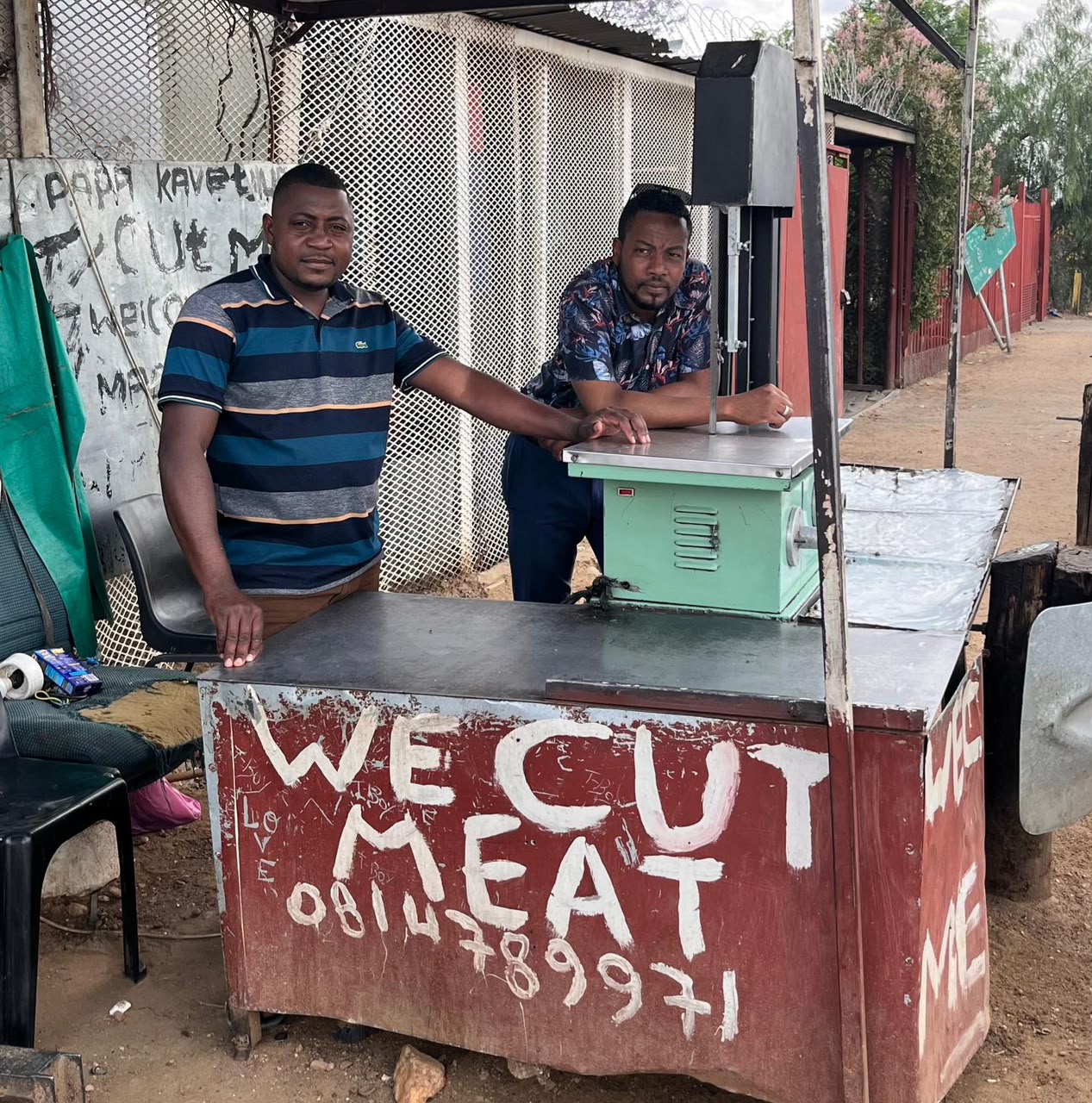
For years, the words “We cut meat!” were a familiar sight on Katutura’s street corners. Today, the signs remain silent witnesses to a business brought to its knees by foot-and-mouth disease (FMD).
The sound of chain saws cutting meat has faded. For meat cutters and traditional food vendors, the outbreak has meant lost customers, falling incomes and mounting bills. Some have closed their businesses. Others sit and wait, hoping someone will come.
Torres Tjatimua, a father of three, has not cut meat for a customer since the government tightened restrictions on the movement of cloven-hoofed animals and meat products following the detection of FMD in the Karasburg district in September.
“The FMD has really hurt my livelihood and I have been forced to close my business. I have not made a single dollar since the outbreak was announced in September,” he told Namibia Business Review.
Tjatimua’s monthly income has fallen from N$6,000 to zero. His bills have not stopped, and neither have his responsibilities to his children.
Ten years ago, after years of unemployment, he invested in a commercial high-speed meat cutter and a bone saw bought from Cymot. The equipment allowed him to become his own boss.
His working day used to begin at 08h00. He would cut frozen meat into strips, cubes, chops and cutlets for customers.
Now, there is little work.
“There are no customers. Nobody is going to spend money on cutting meat when there is no meat or it’s too expensive,” he said.
He is calling on the government to assist meat cutters whose only source of income is the trade.
‘We cannot afford food’
At Herero Mall, traditional food vendor Gerson Zaongara is facing a similar struggle.
His business depends on meat products such as beef bones, beef tongue, goat heads and trotters. But the prices he pays to butcheries have doubled since the outbreak began, forcing him to close his business.
“We are calling for the government to intervene. I make an honest living selling beef bones, goat heads and tongues but now I can’t afford to buy food for my family,” said Zaongara, a father of four.
Rent, water and electricity bills continue to accumulate, even though his business is no longer bringing in money.
He says affected traders would welcome government assistance, including food subsidies.
“This outbreak has impacted my way of life and my family. The government has to look at us and see that we are suffering. Even if the government can assist us with food bank subsidies,” he said.
Zaongara said business owners were willing to help the government with the vaccination process in exchange for financial assistance.
“We are not calling for free things. We can help the government with vaccinating the cattle and livestock or spraying the trucks and facility floors,” he said.
In Soweto, 29-year-old Seven Hikuam has also closed his meat-cutting business after customers stopped coming.
He had operated as a meat cutter for ten years and earned about N$5 000. He has since resorted to charging N$20 per kilogram in the hope of making enough to buy food.
His landlord, however, still expects the rent to be paid on time.
“I just want the government to help us and we are stranded. I am just sitting here waiting for customers. I have even resorted to cutting meat for N$20 in hopes that I can buy bread for my kids,” he said.
At Single Quarters, meat cutter Titus Harukonga says he can go an entire day without seeing a customer.
“We are just sitting all day and there is no meat to cut. I have not made any money since September,” he said.
Harukonga has worked at the site for five years. On a good day, he could earn N$700. Now, he says the loss of income has left him severely stressed.
“Kids need food and I have to pay N$600 for taxi, gas for cooking,” he said.
PROTECTING A N$16 BILLION INDUSTRY
While small traders struggle to survive, the government faces pressure to contain the outbreak and protect the wider livestock industry.
Independent Patriots for Change (IPC) shadow minister of agriculture Michael Mulunga said it was not feasible for the government to provide financial assistance to every affected farmer and small business while fighting the outbreak.
“Who are you going to support from Karasburg to Oshivelo? Everyone is affected by this outbreak. Currently the government is calling for the assistance of the public. How can we support those affected?” he said.
Mulunga said the priority was to contain the outbreak and prevent it from spreading to other regions, safeguarding the livestock industry valued at N$16 billion.
He said the government had an emergency fund to assist if the outbreak continued for a prolonged period.
“Currently all measures are being taken seriously to contain this outbreak. The decision is to protect the N$16 billion livestock industry that is at stake,” he said.
He acknowledged the hardship facing affected businesses but said the impact on meat exports also had to be considered.
“I can sympathise with the livelihood of those affected but we need to look at the impact on our exports. Unfortunately it’s a lot of pressure but there is a N$16 billion industry at stake,” he said.
The private-sector-backed FMD Support Fund has raised N$12.7 million to support the government’s Veterinary Services efforts to contain the outbreak.
CALLS FOR SHORT-TERM GRANTS
Economist Trofimus Sheefeni warned that small businesses dependent on livestock and red-meat sales were unlikely to survive prolonged restrictions without financial support.
“In my assessment, most small-scale businesses that depend heavily on livestock and red-meat sales are unlikely to withstand prolonged disruptions without some form of financial support,” he said.
Sheefeni proposed short-term emergency grants for businesses such as kapana sellers, meat cutters, traditional food vendors and small butcheries. He said assistance should be targeted, time-bound and based on demonstrable losses.
He also suggested low-interest loans or working-capital assistance to help affected farmers, transporters and abattoirs meet essential costs and retain workers.
The longer the disruption continues, he warned, the greater the risk that temporary cash-flow problems will turn into permanent closures and job losses.
“From an economic perspective, the longer these disruptions continue, the greater the risk that temporary cash-flow problems will become permanent business closures, job losses and reduced household incomes,” he said.
Sheefeni said informal traders were particularly vulnerable because they often had limited savings, no insurance and little access to affordable credit. Meanwhile, costs such as rent, electricity and transport continued even when sales fell.
He warned that the effects could spread beyond meat sellers to livestock transporters, abattoirs, feed suppliers, cold-storage facilities, wholesalers, market vendors and restaurants.
“The meat trade operates as an interconnected economic system. When livestock movement, slaughtering or meat distribution is disrupted, the effects can spread to livestock transporters, abattoirs, feed suppliers, cold-storage facilities, wholesalers, market vendors and restaurants,” he said.
Economist Turimuje Uandara also said short-term grants were a possible way to help verified businesses that had lost income because of FMD-related closures or restrictions.
Namibia’s FMD Support Fund has secured N$12.76 million, but Uandara said it was intended primarily for disease prevention, veterinary preparedness and emergency response, rather than direct cash grants to small businesses.
“The government could consider a complementary, time-bound relief programme, working with the Ministry of Finance, the Ministry of Agriculture, and industry associations,” she said.
Uandara said any relief programme would need a clear funding source, transparent eligibility criteria and an accessible application process. The government would also need to establish how many businesses had been affected and how much assistance would cost.
COMMENTS