
TIRI MASAWI
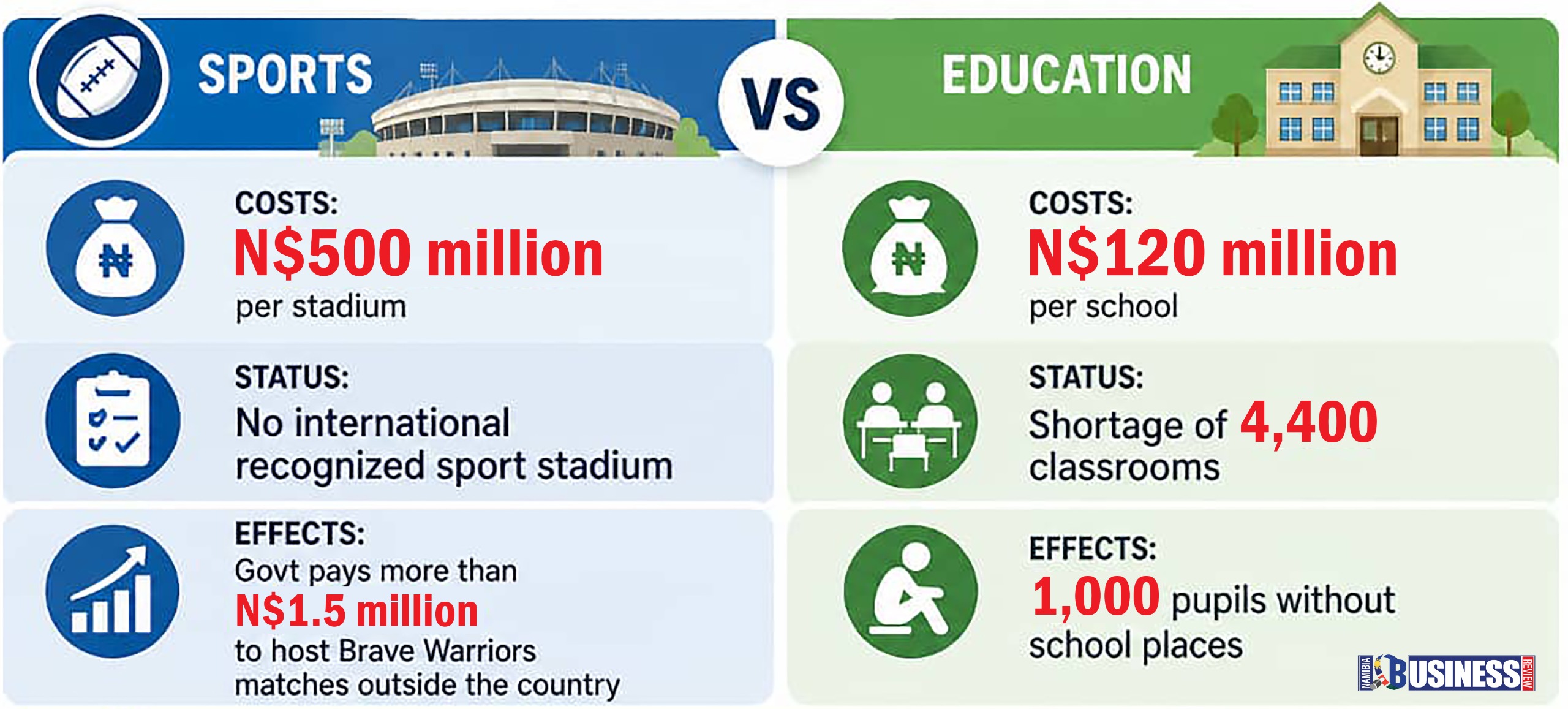
The Ministry of Education, Innovation, Youth, Sport, Arts and Culture is facing a difficult decision, whether to build schools that cost about N$120 million to ease classroom shortages, or construct stadiums that could cost up to N$500 million to meet international standards.
The ministry is looking at building major sport stadiums at Katima Mulilo, Mariental and Opuwo but architectural designs alone could cost up to N$70 million with one stadium expected to cost about N$500 million on completion.
Minister Sanet Steenkamp says the choice comes down to limited resources and growing demands across both sectors.
Speaking to the Parliamentary Standing Committee on Education, Youth, Civic Relations and Community Development last week, she said government must decide how best to use the money available.
“As a country, we should decide whether to construct one stadium for more than half a billion. For juxtaposing, we construct schools now for N$120 million and this is where the ministry says we must really come up with a blueprint,” she said.
PLANS HIT A COST WALL
Government had committed to building stadiums across the country, but those plans have been disrupted.
The Confédération Africaine de Football (CAF) introduced strict design requirements for stadiums to meet international standards, pushing costs higher than initially expected.
Steenkamp said design and documentation alone for stadiums in Katima Mulilo, Mariental and Opuwo could exceed N$70 million.
“That’s because of the high cost of international standards. Can we move forward with the plans and designs that are to be constructed because we know it will be problematic to get a budget and to finish in the phase that we intend to,” she said.
CLASSROOMS STILL MISSING
While stadium plans are under pressure, the education sector faces its own urgent needs.
Some schools across the country do not have enough classrooms, forcing learners into overcrowded spaces or makeshift structures.
Namibia faces a chronic shortage of over 4 400 classrooms, leaving over 1 000 pupils without school places in early 2026, particularly in the Khomas and Erongo regions.
This has added pressure on the ministry to prioritise building more schools.
A COUNTRY WITHOUT A HOME STADIUM
At the same time, Namibia has gone seven years without a stadium that meets international standards.
This has forced the national football team, the Brave Warriors including the national womens team, to play their home matches in other countries, increasing costs.
The government pays more than N$1.5 million per match to host them abroad.
STADIUMS BRING VALUE TOO
Economist Omu Kakujaha-Matundu says the construction of stadiums is long overdue.
“The government has weighed the trade-offs, the reason why it neglected the construction of sports stadiums,” he said.
He added that N$500 million is not excessive if the project is managed properly.
“The main thing is that the companies procured to do the job should be entities with a good track record. That will avoid inefficiencies that could lead to cost escalation,” he said.
According to him, large construction projects create jobs and stimulate economic growth.
“With a high marginal propensity to consume, the multiplier effect could be quite strong,” he said.
He also highlighted the role of sport in youth development.
“Sports for schools have been neglected. It deprived the nation and young people from becoming professional sports people,” he said.
Analyst Ndumba Kamwanyah says the trade-off is clear.
“Spending over N$500 million on one stadium means giving up several priorities such as schools, clinics, or roads,” he said.
“A stadium brings national pride, tourism, and allows teams to play at home, but schools directly improve education and long-term economic growth.”
He said government should focus on projects with the biggest long-term impact.
“In simple terms, one stadium at N$500 million equals about four schools,” he said.
A BALANCING ACT
Former Namibia Football Association vice president Izak Fredericks says the country is facing a classic development dilemma.
He said Namibia must balance international sporting standards with urgent domestic needs, all within a tight budget.
“The trade-off isn’t just stadium or school. It’s about opportunity cost, economic returns, and national identity,” he said.
Fredericks explained that schools offer long-term benefits linked to jobs and economic growth, while stadiums generate returns mainly during events.
Fredericks said hosting matches at home would reduce costs, but not enough to recover the full investment quickly.
“Education addresses unemployment and skills gaps, while sport builds cohesion and national pride. Both matter, but schools are a constitutional right; stadiums aren’t,” he said.
Fredericks said high costs are driven by international standards, which require specialised infrastructure such as lighting, media facilities and large seating capacity.
He also warned that consultancy and design costs are rising, consuming large portions of project budgets.
To manage costs, he suggested phased construction, building essential parts first and expanding later.
He also recommended using standardised designs and upgrading existing stadiums instead of building new ones.
Fredericks proposed building one main stadium that meets international standards, while developing smaller regional facilities.
This approach, he said, would balance affordability with the need to host international matches.
Social justice activist Herbert Jauch says government must focus on urgent needs first.
“Education, health care and housing are among the most urgent,” he said.
“Sports facilities rank a bit lower and should predominantly serve local needs cost-effectively.”
However, he acknowledged the need for at least one stadium that meets CAF standards.
COMMENTS