
IMELDA AMBONDO
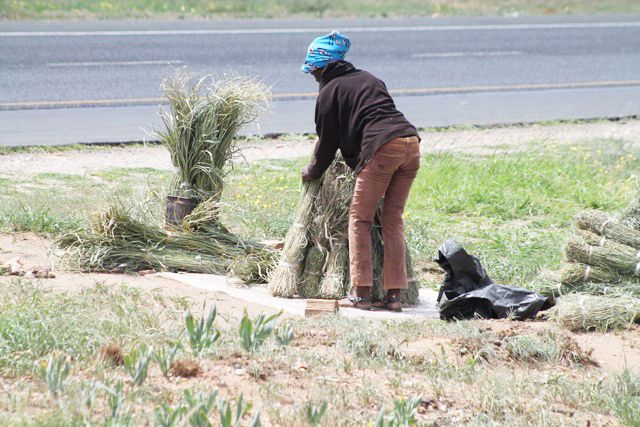
Namibia’s unemployment crisis is not just reflected in statistics, it is visible on the roadside. In Windhoek alongside the B1 road enroute to Okahandja, women spend their days selling bundles of dry grass to feed their children and keep their households afloat.
Every morning at 08:00, Theopolina Mekubali (57) walks from Okahandja Park to the B1 highway. With no formal job, she survives by cutting grass along the bushes, leaving it to dry before tying it into bundles. She sells them to people who use the grass to feed livestock and build houses.
She spends the whole day under the open sky, facing the burning sun and hoping passing cars will stop to buy a bundle or two.
“We are suffering, we come here and spend the whole afternoon and customers don’t even come and buy our grass,” she said.On a good day, Mekubali earns between N$50 and N$200.
On some days, she goes home with nothing. To survive, she collects empty cans and sells them at the scrapyard to add to whatever little she makes from the grass.
Despite being chased away by authorities for selling in a prohibited area, she keeps returning.
“It’s the only way we can get something to eat, and provide for our families,” she said.
Nearby, Anna Mupenda (61) arrives after a 30-minute walk from Okahandja Park. From 08:00 to 17:00, she waits by the highway with her grass bundles. At the end of the month, she makes between N$800 and N$1 300.
“The money is not enough to support myself, three children, and four other family members who rely on me. The money is little, things like macaroni, rice, sugar, and maize meal are expensive,” Mupenda said.
Because of the shortage, her children often go without basic school necessities. Still, she stands there daily, hoping for a buyer, knowing the day may end without one.
For Given Haufiku (48), the journey begins even further away. She walks from Oshitenda location to the highway, cuts grass and sells it for N$5 per bundle. On a good day, she makes about N$150.
She provides for her six children, aged between three and 18 years. What she earns is not enough to feed them all.
“I would like to ask for any assistance that people can provide for me and my family, food, money or anything,” she pleads.
Their daily struggle mirrors the broader national picture.
According to the Namibia Statistics Agency’s 2023 Census Labour Force Report released on 29 January 2025, the official unemployment rate stands at 36.9%. When discouraged job seekers are included, the rate rises to 54.8%. Youth unemployment is particularly high at 44.4%.
The high rate of unemployment in Namibia has pushed many people into informal trading, settling for anything that can bring food to their homes.
Rinaani Musutua of the Basic Income Grant Coalition of Namibia says the country’s socio-economic situation shows a direct link between poverty and societal chaos. She points to Namibia’s 50% unemployment rate, the highest in the Southern African Development Community (SADC) , which leaves many without formal employment.
She describes this as a failed economy “forcing individuals to engage in street vending at unsolicited locations as a desperate means of survival.”
Musutua says this creates what she calls “survival anxiety.” To ease the pressure, she proposes a Universal Basic Income Grant of N$500 per person per month for all Namibians aged 0–59, saying it would help subsidise basic necessities and reduce daily struggles.
COMMENTS