
IMELDA AMBONDO
When a drought wiped out her goat herd in 2022, Fransfontein farmer Ingrid Heigan thought she would lose everything.
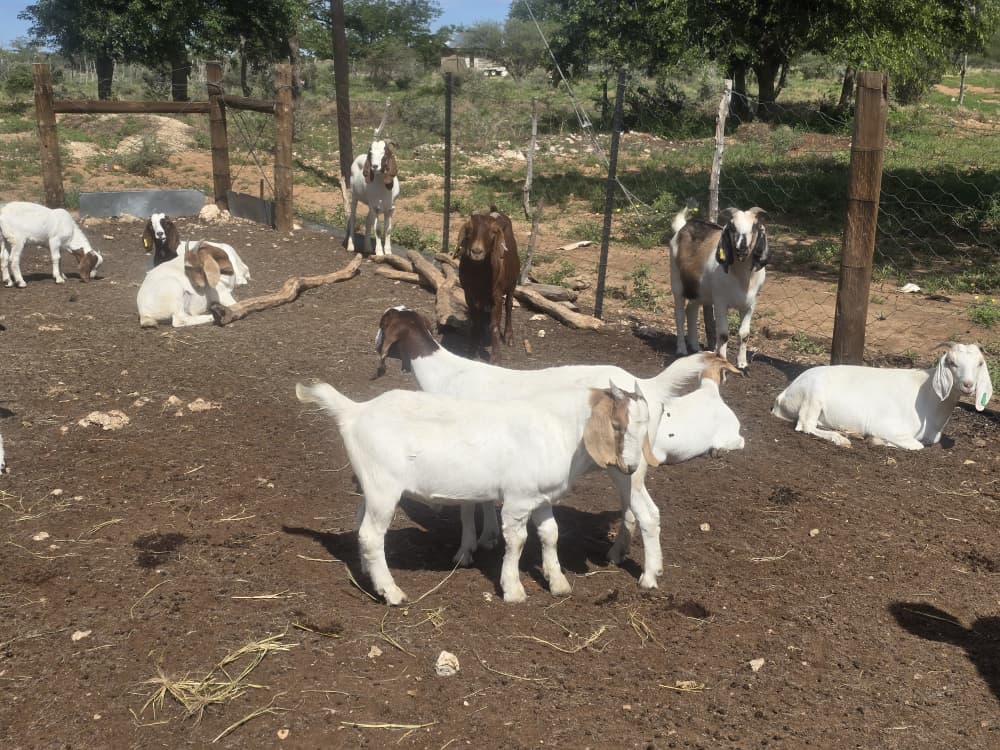
Four years later, she owns nearly 100 goats, employs her children, and contributes to community projects. This is all thanks to the Environmental Investment Fund (EIF)-supported Improving Rangeland and Ecosystem Management Practices of Smallholder Farmers under Conditions of Climate Change (IREMA) goat scheme.
The IREMA project, implemented in Sesfontein, Fransfontein, and Warmquelle, provides smallholder farmers with goats and training to improve livestock management, boost food security, and strengthen resilience against climate change.
“It was very helpful to me, because I am a female farmer with no husband to support me. I just had seven goats when I started, then EIF gave me 21 goats which was really helpful because it boosted my kraal,” Heigan says.
Her goats have not only multiplied, but she has also returned 21 female goats to EIF to keep the project revolving. “Since then I have been standing strong and I have close to 100 goats, all thanks to the EIF goats that I got,” she adds.
Heigan auctions her goats at the nearby town of Khorixas, selling big ones for N$1 500 and smaller ones from N$1 000 to N$1 200. The project’s success has also inspired her to explore poultry farming, and she has already attended training with Agribank to produce eggs.
Her daughter, Mutagos Heigan (31), has now joined the family business. “I am proud of my mother, a strong woman with no husband and now I’m interested in being a farmer also, she encourages me to go into the farming industry which I see is beneficial,” she says.
Another Sesfontein farmer, 51-year-old Seth Murorua, says he started with seven goats before receiving 21 through the government-funded project, which came after the 2022 drought nearly wiped out his herd.
“My goats died because of the drought, they were starving and there was not enough. These projects are really good for us, they have helped a lot of people with this project,” he says, noting that climate change has drastically affected farming opportunities.
In Warmquelle, Johannes Swanapoel, manager of a Green Scheme Project and IREMA beneficiary, runs a 16-hectare garden that has been operational for over two years. His project employs 35 to 40 community members and supplies food to local hostels and other institutions across Namibia.
Even with scarce water, Swanapoel has kept production going. “We don’t have proper access to water here, we get water from Fransfontein. Even in a dry climate we are producing well in a semi-desert hot and warm community, although 30 to 40% of goods get ruined due to problems like pesticides, chemicals and climate changes,” he says.
EIF spokesperson Romeo Muyunda said more than 10 000 smallholder farmers have benefited directly from the five-year climate change adaptation project, which improved food security, income generation, and climate resilience.
“The project funded to the tune of N$164 million significantly improved the resilience of smallholder farmers and rural communities in the drought-prone areas of Sesfontein, Fransfontein and Warmquelle,” Muyunda said. He added that the initiative reached an estimated 68 600 people, far exceeding the original target of 21 000 beneficiaries.
“The project placed strong emphasis on supporting vulnerable households, particularly women and small-scale farmers, to strengthen their ability to cope with recurrent drought,” he said.
Ministry of Agriculture, Fisheries, Water & Land Reform technician Anton Joseph confirmed that many farmers benefited from the goat revolving scheme.
“We provide necessary farming training on how to care for the goats and basic aspects of livestock farming to all the beneficiaries before handing over the goats. We continue this process until everyone benefits from it, and we prioritise farmers who have not more than 10 goats already, strictly farmers who stay on their farms,” Joseph said.
Agricultural Minister Inge Zaamwani-Kamwi last year encouraged Namibian farmers to adopt sustainable methods to reduce the effects of climate change.
“Farmers need to adjust their farming methods to avoid incurring losses in instances when the rainfall is not consistent,” she said. “The effects of climate change are realistic in modern day and can have detrimental effects to the farming communities.”
COMMENTS