
STAFF WRITER
Market sentiment around the viability of Namibia’s green hydrogen industry is improving, although securing future offtakers remains one of the sector’s key challenges.
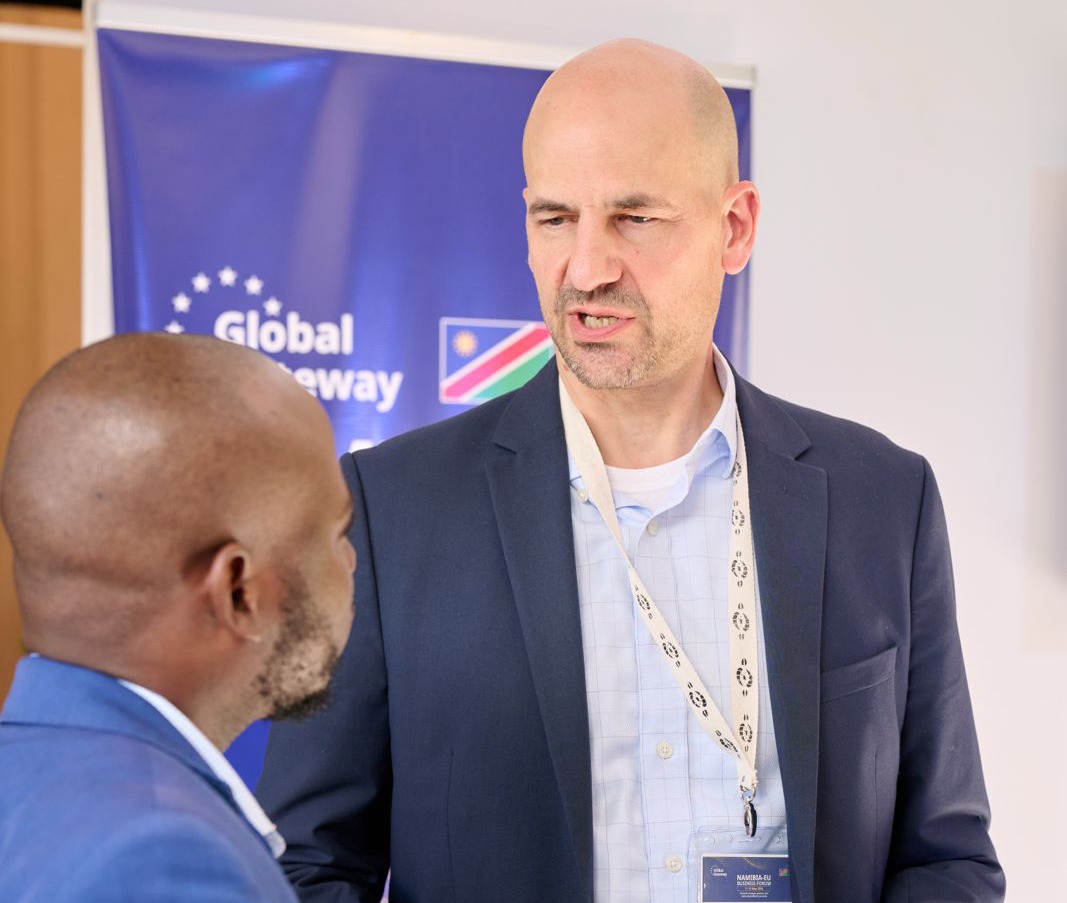
This is according to the senior advisor at GET.invest and the Green Hydrogen Business Alliance (H2BA) Michael Neulinger.
Neulinger said the investor confidence in Namibia’s green hydrogen sector has strengthened in recent years as projects continue to take shape.
Speaking at the recently held Namibia-EU Business Forum on Wednesday, Neulinger told Namibia Business Review that Namibia is making steady progress in developing a green hydrogen industry.
“We have seen an improvement in the past few years in terms of market sentiment and we are funding different initiatives and mechanisms to make sure that the industry takes off,” he said.
He added that “we have so far worked with the government to establish a policy framework for the green hydrogen industry, which is vital in moving the industry forward.”
The Green Hydrogen Business Alliance is an initiative supported by the German Federal Ministry for Economic Cooperation and Development (BMZ) and implemented by Deutsche Gesellschaft für Internationale Zusammenarbeit (GIZ). The initiative aims to support a market-driven and socially inclusive transition to green hydrogen and Power-to-X products in countries including Namibia, Brazil and South Africa.
Meanwhile, Namibia Green Hydrogen Industry acting head Joseph Mukendwa said several green hydrogen projects are currently under development in Namibia, helping to build confidence in the sector’s long-term prospects.
“There are several green hydrogen projects that are developing in Namibia. The industry is part of the country’s development programmes like Vision 2030,” Mukendwa said during the Namibia-EU Business Forum last week.
Mukendwa said “this is where we are coming from and the focus is to move Namibia into a developed country. We continue to make progress on most of the projects that are being developed.”
However, he acknowledged that securing long-term offtakers remains a challenge for the sector.
“Currently challenges are still in finding key offtakers in the future, but there is an ongoing process to deal with this in future,” Mukendwa said.
National Planning Commission executive director I-Ben Nashandi said stronger alignment between policy frameworks, financing instruments and implementation timelines will be critical for Namibia to achieve its green hydrogen ambitions.
“The Government of the Republic of Namibia has approved the establishment of the Green Industries Council, which will serve as the principal inter-ministerial coordinating body, facilitating cross-sectoral collaboration and policy harmonisation within the broader green economy,” Nashandi said.
He urged European partners to accelerate the development of demand-side support mechanisms that can provide bankable offtake commitments needed to support investment decisions.
Nashandi also called for deeper technical and financial partnerships to help move projects into implementation.
“The time for feasibility is passing. The time for implementation has arrived,” he said.
“Let us use this Business Forum not as a conclusion, but as a catalyst for structured follow-up engagements, a catalyst for bankable projects and a catalyst for a renewed and reinvigorated partnership that delivers at scale and with impact. Namibia is ready to be a reliable, large-scale, and competitive supplier of green hydrogen and its derivatives.”
COMMENTS